


The Old Farmer's Almanac: Folklore or Farmer's Best Friend?
If you've grown up around farming communities, you've probably heard the following says and have some of your own to share:

-Knee high by the 4th of July.
-Never plant before Memorial Day.
-Smells like rain, the flies are biting, or my knee hurts, so it's gonna be a doozy.
-Red sky at night, sailor's delight. Red sky in morning, sailor take warning.
-Ring around the Moon? Rain or snow real soon.
Walk into almost any farmhouse in the Midwest and there's a good chance you'll find an old almanac tucked into a kitchen drawer, sitting on a bookshelf, or hanging on a nail in the shop. Around here, some folks check the weather app. Then there are the people who won't plant potatoes until the Almanac says it's time.
I can recall my Grandpa saying, "The Old Farmer's Almanac called for a wet spring."
Maybe someone in your family has told you, "Grandpa always planted beans after the full moon, and I'm not about to argue with 80 years of experience."
The Almanac...
Some folks swear by it. Others swear at it.
So what's the real story behind the Farmer's Almanac and the Old Farmer's Almanac?
Is there any truth to the predictions, or has it simply become one of agriculture's most beloved traditions?
Two Almanacs, One Common Misconception
One of the biggest misconceptions is that there's only one Farmer's Almanac.
There are actually two completely separate publications.

The Old Farmer's Almanac
was first published in 1792, making it the oldest continuously published periodical in North America. It continues to publish today and offers weather forecasts, gardening advice, recipes, astronomy, folklore, and practical household tips.
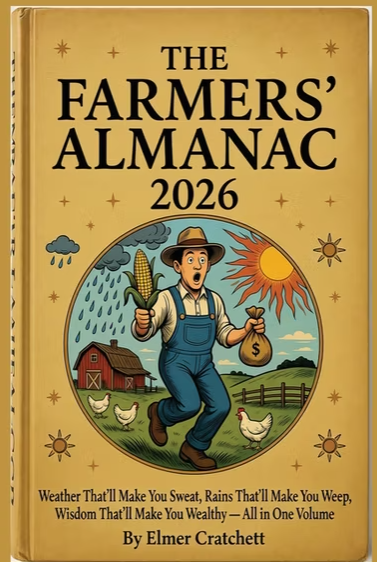
The Farmers' Almanac
came later, first appearing in 1818. While similar in style, it developed its own loyal following with long-range
weather predictions, gardening
calendars, recipes, and country wisdom.
In late 2025, its longtime owners announced publication would end due to financial pressures. Fortunately for longtime readers, new ownership stepped in during early 2026 with plans to preserve both the website and future print editions.
Rather than disappearing completely, the publication is entering a new chapter.
Why Did Farmers Trust It?
Long before smartphones, weather apps, Doppler radar, and satellite imagery, farmers had to rely on observation, experience, and a healthy dose of optimism.
An almanac was often one of the few affordable sources of information available each year. It combined:
Weather predictions
Sunrise and sunset times
Moon phases
Planting calendars
Fishing and hunting advice
Household remedies
Recipes
Humor
Agricultural tips
It wasn't simply a weather guide—it was an annual handbook for rural life.
Families often bought one every year, right alongside the new seed catalogs. Around many kitchen tables, the arrival of the Almanac was almost as much a sign of spring as the first robin or hearing someone say, "The frost is finally out of the ground."

The Famous Weather Forecast
Perhaps the biggest reason people still buy an almanac is its long-range weather forecast.
Both publications claim to use proprietary forecasting formulas that combine astronomy, historical weather patterns, solar activity, tidal influences, and other natural cycles. The exact formula remains one of agriculture's longest-kept secrets.
Modern meteorologists, however, generally don't consider these methods scientifically reliable. Independent reviews suggest long-range forecasts are accurate about 50–55% of the time, making them better suited as broad seasonal outlooks than precise forecasts.
Of course, if you've ever lived through a Minnesota spring, you know even the professionals can miss the mark. Around here we joke that if you don't like today's weather, just wait fifteen minutes...then grab a sweatshirt, because it'll probably snow anyway.

Planting by the Moon...or by Grandpa?
Another hallmark of both almanacs is lunar gardening which settlers learned from the First Nations they lived among on the prairies and plains of the US.
The idea is simple:
Plant above-ground crops during certain moon phases.
Plant root crops during others.
Schedule pruning and harvesting according to the moon and zodiac signs.
Science hasn't found strong evidence that moon phases directly influence plant growth the way these calendars suggest. But ask around at the local coffee shop or feed mill, and you'll probably hear a different opinion.
There's always that one customer who says, "I've planted by the signs for forty years, and I'm not changing now."
And honestly...if Grandpa raised beautiful gardens for sixty years by watching the moon, who's going to tell him otherwise?
There is often wisdom passed down for certain areas, growing patterns and conditions that can't always be quantified by "proof."
More Than Weather Predictions

The real charm of an almanac has always been everything else.
Readers continue to enjoy:
Time-tested recipes
Gardening advice
Natural remedies
Historical stories
Household tips
Astronomy guides
Wildlife observations
Country humor
Many of these practical tips have been passed down through generations and still hold plenty of value today. After all, farming has always been about learning from those who came before us.
So...Should You Believe It?
Maybe that's the wrong question.
Instead of asking whether an almanac is always right, perhaps it's better to ask why it's still around after more than 230 years.
The answer isn't just weather.
It's tradition.

Sitting around the kitchen table with your grandparents debating whether winter will be hard because the squirrels are gathering more acorns.
It's your neighbor insisting he won't cut hay until after a certain moon phase.
It's the customer who walks into Widdes every spring and says with complete confidence, "The Almanac says we're safe now," while everyone else quietly glances at the forecast calling for frost next Tuesday.
Today's farmers have tools our great-grandparents could only dream about-satellite imagery, GPS guidance, precision agriculture, university research, and highly advanced weather models. Those resources should absolutely guide important farming decisions.
But there's still something comforting about flipping through an old almanac while drinking coffee before chores and the simple truth that sometimes there's nothing new under the sun.
History, weather, seasons, and wisdom of old weaves itself into our lives today.
Maybe it's because farming has never been just about data.
It's about stories.
It's about traditions.
It's about trusting your experience, listening to your neighbors, and occasionally arguing over whether the Almanac got it right this year.
And if you're wondering whether you should still plant those potatoes this weekend?
Well...we're not taking sides. (but yes, do it. You'll have little wee cutie taders this fall)
We'll just be here at the feed store listening to both camps debate it over coffee.
Because if there's one thing Midwestern farmers enjoy almost as much as farming...
...it's discussing the weather!
*Check out these sites that helped us make this blog come true:


Comments